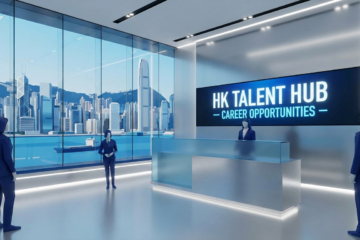
The Great Credential Shift: Micro-credentials vs. Degrees in the 2026 HK Market
It is a humid Tuesday morning in Central, 2026. In a high-rise office overlooking the Victoria Harbour—now bustling with autonomous ferries—a hiring manager named Sarah pulls up two holographic candidate profiles on her desk.
Candidate A holds a Master’s degree in Marketing from a prestigious university, obtained in 2021.
Candidate B holds a Bachelor’s degree from 2018, but their profile is stacked with verified digital badges earned in the last 18 months: *Advanced AI Prompt Engineering, Regulatory Compliance for Virtual Assets,* and *Data Visualization for Decision Making.*
In 2020, Candidate A was the safe bet. In 2026, Sarah hesitates. She knows the marketing landscape has been rewritten three times over since Candidate A graduated. She calls Candidate B for the interview.
This scenario is becoming the norm across Hong Kong’s professional landscape. As we settle into the latter half of the decade, the debate between the four-year degree and the targeted micro-credential has moved from academic theory to the front lines of recruitment.
## The Shifting Sands of the Harbour: The Context of 2026
To understand the value of credentials, we must first understand the market. By 2026, Hong Kong has firmly established itself as a dual-engine economy: a traditional finance hub and a burgeoning Web3 and Biotech center. The Northern Metropolis development is live, demanding a workforce that is not just educated, but technically agile.
The defining characteristic of the 2026 workforce is the **”Half-Life of Skills.”** Research suggests that the lifespan of a learned technical skill has dropped to roughly 2.5 years. This acceleration, driven by the maturity of Generative AI, has created a paradox: we need deep knowledge, but we need it updated constantly.
### The Algorithm of Hiring
Furthermore, Applicant Tracking Systems (ATS) in 2026 have evolved. They no longer just scan for university keywords; they scan for verified competency blocks. They look for evidence of *recent* learning, favoring candidates who can prove they understand the tools of today, not the theories of yesterday.
## The Case for the University Degree: The Foundation Layer
Does this mean the university degree is dead? Far from it. In Hong Kong, a society that deeply values pedigree and academic rigor, the degree remains the **Foundation Layer**.
### The Signal of Resilience
For Alpha HR clients, particularly in traditional sectors like Law, Civil Service, and Corporate Banking, a degree signals more than just knowledge. It proves resilience. Completing a four-year program demonstrates the ability to commit to long-term goals, navigate complex bureaucracies, and socialize within a structured environment.
### Critical Thinking Over Coding
While AI can write code and generate copy in 2026, it still struggles with high-level strategic synthesis and ethical judgment. University programs have pivoted to focus intensely on these “human-centric” skills. A degree in Philosophy or History, once mocked as impractical, is seeing a resurgence in value as companies seek leaders who can ask the right questions of their AI tools.
## The Rise of the Micro-Credential: The Agility Factor
However, the degree is no longer the *only* thing that matters. It is the entry ticket, but micro-credentials are the seat upgrades.
Micro-credentials—short, competency-based recognitions often backed by industry giants or specialized institutes—have exploded in popularity. In the Hong Kong market of 2026, they solve the “Speed to Competence” problem.
### 1. The Fintech and Web3 Demand
Hong Kong’s push into virtual assets and digital currency requires skills that didn’t exist when many current mid-level managers were in university. You cannot get a four-year degree in a regulatory framework that was written six months ago.
* **The Trend:** Professionals are using micro-credentials to “patch” their operating systems. A compliance officer might take a 6-week intensive certification on *HKMA Crypto-Regulations* to remain employable.
### 2. Just-in-Time Learning
Employers are increasingly unwilling to pay a premium for skills they don’t need yet. They practice “Just-in-Time Hiring.”
* **The Trend:** Instead of hiring a generalist with an expensive MBA, companies are hiring sharp generalists and paying for them to acquire specific micro-credentials (e.g., *Sustainability Reporting for HKEX*) immediately upon hiring. This reduces the time-to-productivity window significantly.
### 3. Verification on the Blockchain
One of the biggest hurdles for micro-credentials in the early 2020s was trust. *Is this online course legitimate?* By 2026, blockchain-verified credentialing has solved this. When a candidate claims a micro-credential, it is instantly verifiable, tamper-proof, and standardized. This has given HR departments the confidence to weigh these badges almost as heavily as traditional diplomas.
## The 2026 Verdict: The “Stacked” Portfolio
So, who wins the battle? In the eyes of Alpha HR, the winner is the **Hybrid Candidate**.
The binary choice between “Degree” vs. “Micro-credential” is a false dichotomy. The most highly sought-after talent in Hong Kong possesses a “Stacked Portfolio.”
### The T-Shaped Employee 2.0
We used to talk about T-shaped employees (deep expertise in one area, broad knowledge in others). In 2026, we are looking for **Comb-Shaped** employees.
* **The Handle:** A university degree provides the foundational handle—the critical thinking, the soft skills, and the cultural context.
* **The Teeth:** A series of deep, constantly changing micro-credentials represent the “teeth”—specific, sharp technical skills that can be swapped out as technology evolves.
### Advice for Employers
For companies looking to hire in this market, the strategy must shift. Stop filtering purely by university ranking. Start looking for the “Learning Velocity” of a candidate.
* Look at the dates on their certifications.
* Value a candidate who completed a rigorous nanodegree *while* working full-time over a candidate with a prestigious degree who hasn’t upskilled in five years.
### Advice for Talent
For job seekers, the message is clear: Your degree got you into the room. Your micro-credentials will get you the seat. If your CV ends at your graduation year, you are signaling stagnation. In the fast-paced ecosystem of Hong Kong, stagnation is the only true failure.
## Future-Proof Your Workforce with Alpha HR
Navigating the nuances of the 2026 talent landscape is complex. Whether you are an organization looking to build an agile, skills-based team, or a professional looking to position yourself as a leader in the new economy, you need a partner who understands the changing tides.
At Alpha HR, we don’t just fill vacancies; we analyze the skills matrix of the future. We help you identify candidates who possess the perfect blend of foundational education and cutting-edge agility.
**Ready to build a workforce that can weather the changes of tomorrow?**
[Contact Alpha HR Today] to discuss your talent strategy.